
Year of Mercy – Loving our Neighbour
At the Waaseandimikaaning September board meeting it was decided to include the sharing of the story of the Solidarity visit to the Diocese of San Cristobal de Las Casa and the Indigenous peoples of Chiapas, Mexico to celebrate the legacy of Bishop Samuel Ruiz trip, and to share this more broadly with those in local Native ministry at the parish level, while engaging the concepts of de-colonization of native ministry, and sharing local faith based activities with one another.
A committee was struck with a rep from each major community. A pamphlet was designed to send by e-mail and regular mail to DOS and those in the Ministry program to distribute to councils as far north as Thunder Bay and east to Garden Village. The brochure was sent at the end of October from the office.
Highlights from the weekend are:
We began a New Church Year – ADVENT 2016
We shared community-based activities with one another (resources, children’s sacraments, liturgy, music, fundraising, bulletins, outreach, etc.)
We explored a path for future cooperative initiatives.
We explored de-colonization in the Native Church of Canada (Chiapas presentation)
We facilitated small group conversation on 1.) Liturgy 2.) Community Building 3.)Administration which led to encouragement and inspiration for future initiatives.
We introduced the Pastoral Cycle as a process for decision-making.
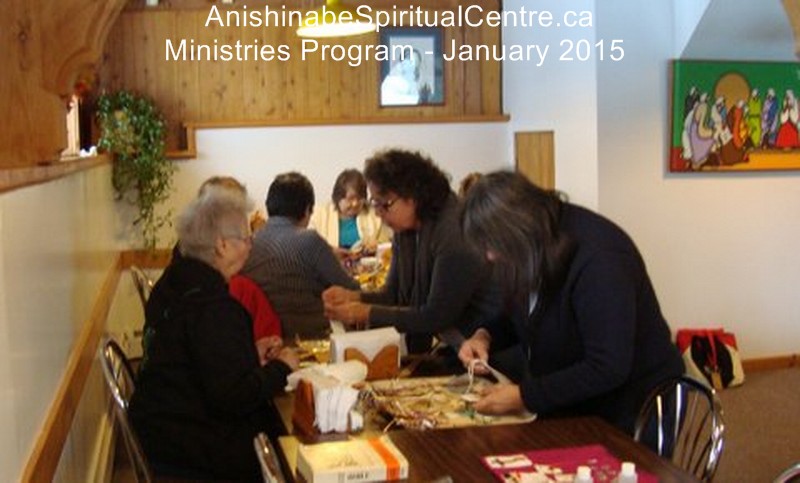
We created an Advent wreath with each person adding cedar to the wreath.
An Advent Wreath Prayer was shared with participants, for them to take home to their parishes.
Who was there?
- Six DOS members were present: Rosella Kinoshameg, Debbie Ense, Pauline Toulouse, Dianne Musgrove, Marjorie Trudeau, Marjorie Spanish
- 20 members from 4 parish communities: Sagamok, Birch Island, M’Chigeeng, Wikwemikong.
- 3 Jesuits: Fr. Gerry McDougall, Fr. Tony Baranowski, and Fr. Philippe Landenne.
What did people experience?
“I think the weekend inspired our parish to work together, … all the communities realized how much teamwork is needed to keep our parishes up and running, and that the sharing time and coming together was vital. By getting together, it has made us a bigger/closer community, by involving new parish members to see what happens at our ministry weekends. The members from our church were very glad to have attended.”
Debbie Ense – Immaculate Conception Parish M’Chigeeng
“As a floater among all small working groups, I experienced the rich dialogue among the members of each group and how they were sharing ideas of various activities in their own communities and showing the pride in carrying these out to help out in whatever they could or they saw what needed to be done.”
Rosella Kinoshameg—Holy Cross Mission
Wikwemikong
“The topic for our group was “Administration” . For Administration we discussed a) Parish Council Leadership; b) Meetings; c) Bulletins d) Building Maintenance e) Church Records. For most Parish Councils there is no designated chairpersons. The committee is made up of parish community members who show up for the meeting. For other Parish Councils there are chairpersons who are appointed or elected by the Parish Community. Parish Councillors are nominated and voted in by the Parish community. Some church staff are paid a stipend. Most meetings are held on a regular basis, at least once a month. Church bulletins and Public Announcements are usually written by the church secretary. Building maintenance seemed to be a concern for all parishes especially the heating of the church for the Sunday services. Most parishes fundraise to pay for the high cost of heat for their churches. Another concern that the group seemed to find difficult is to get a handle on is how to maintain Church Records.”
Pauline Toulouse —St. Raphael Parish
Sagamok
Participants were inspired by the work parishes are doing to keep the heat on in winter and faith alive among the people’
The parish representatives communicated clearly with one another. Their sharing helped to reassure the good work being done and to give clearer direction to volunteers on how they might make changes in their parish.
Sharing of Scripture in the language at mass is possible in all parishes.
Through Friendship Cafés, brunches, and bingos the parish gives back in community building and sharing food.
Networking in the community is a bridge to those healing from loneliness, loss, bereavement, abuse, and issues such as the missing and murdered Aboriginal women.”
The participants left the weekend more informed and deeply inspired hearing the faith life and discerned actions of our indigenous neighbours in Chiapas.
The weekend provided: opportunity to connect, to belong, to listen and to understand and to lift each other up. We will gather again!