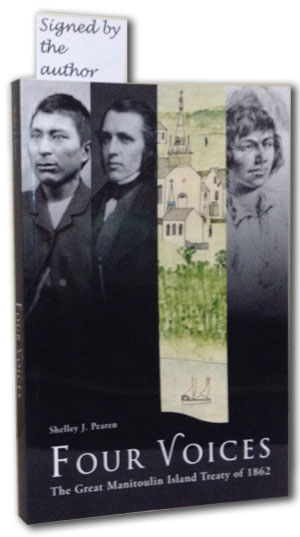
Book: Four Voices – by Shelley J. Pearen

Book: Four Voices - The Great Manitoulin Island Treaty of 1862The Great Manitoulin Island Treaty of 1862

In a remarkable tour  de force of research, Shelley Pearen reveals the innermost thoughts of the people who assembled 150 years ago to negotiate the future of Manitoulin Island, the world´s largest freshwater island. Working with long forgotten letters, reports and accounts written in English, French and Ojibwe. Pearen brings to life the people and events of 1861-63 through the actual words spoken and written by four key participants: William McDougall, head of the government´s Indian Affairs department; Sasso Itawashkash, chief of the Sheshegwaning Anishinaabeg; Jean-Pierre Choné, Jesuit priest at the Holy Cross Roman Catholic Mission in Wikwemikong; and Peter Jacobs, Church of England missionary in Manitowaning, and himself Anishinaabe. For the first time, each of these players is given the stage to explain his own understanding of what actually happened before, during and after the signing of the still-contentious Great Manitoulin Island treaty of 1862. These four voices reveal fascinating personal stories of strengths and frailties.

Four Voices: The Great Manitoulin Island Treaty of 1862, 6″ x 9″, 193 pages with ilustrations, notes and bibliography, published October 2012, ISBN 978-0-9880865-9-9, $25 paperback.

Shelley J. Pearen is the autor of Exploring Manitoulin and co-transcriber/translator with William Lonc S.J. of Letters from Manitoulin, Letters from Wikwemikong, Memoirs of the Jesuit Mission at Wikwemikong, Letters from th Ft. William Jesuit Mission, Letters from the Sault Ste. Marie Jesuit Mission, and Letters from the Jesuit Mission at Sandwich. Ms. Pearen has been researching the history of Manitoulin Island for 40 years.

To purchase a copy of this book please email anishinabe.centre@gmail.com,

The Anishinabe Spiritual Centre has copies of this book signed by the autor.

Book: Four Voices - The Great Manitoulin Island Treaty of 1862
Book: Four Voices – The Great Manitoulin Island Treaty of 1862


Rosella Birthday at Anishinabe Spiritual Centre! – Espanola, Ontario

ASC gathers for our monthly Ministries Programme, a time when Deacons and Diocesan Order of Service (DOS) are invited to learn, share fellowship and pray together. This same weekend of early January, we had the fortunate opportunity to celebrate the birthday of DOS Rosella Kinoshameg. Rosella actively ministers within her community of Wikwemikong, and out in other First Nations communities in the area– Birch Island, Garden River and more, leading wakes, teaching on Native tradition and promoting the Ministries Programme. Rosella also is a member of the Canadian Catholic Aboriginal Council since 2000(CCAC) ; this is the national council that is under the leadership of the Canadian Catholic Bishops. When not doing ministry within the church, as a professional health care worker, she has worked and continues to work in First Nation communities promoting health care and as a consultant. Happy Birthday and may God bless you with a great new year of life.

IMG_0518-600x Pauline Toulouse leans over to help Rosella blow out her candles.
Irene Moses and Ernestine Baldwin look on along with others.

Far left, Gerry Zeigler, the baker and cook, is pleased, she stands along with Fr. David watching if all the candles will be blown out so that the wish will come true. Others seated are Ursula Jocko, Deacon Henk van Meijel, S.J. Loretto McGregor, and Phyllis Kinoshameg.

IMG_0519-600x All the candles are blown out and the great applaud and cheer follows


IMG_0520-600x Birthday cards has been given to Rosella by Fr. David, along with others looking on: Loretto, Deacon Henk, Ursula, Pauline, Fr. David, Rosella, Irene, Ernestine and Joyce Toulouse.

IMG_0521-600x Rosella reads all the birthday greetings,

IMG_0522-600x Rosella still reading, with others and Jean Akiwenzie (left bottom corner) looking on.

IMG_0523-600x A close up of Rosella being well pleased and delighting that she has been another year to do the good work she does and likely more.

IMG_0524-600xRosella goes back and reads the good wishes of others.

My Longest Yard

By Fr. Michael Stogre S.J.

It was in the summer of 1963 that I pulled off my novitiate caper. We were in the midst of a summer holiday and the novice master, Fr. Len Fischer – who would later work with us here in Northern Ontario – was away for his holiday too.

I approached the prison chaplain, Fr. Charlie Carroll, and suggested that we could field a ball team and challenge the inmates to a game – on their turf of course.

And so it was that one evening a paddy wagon arrived at our door and whisked our make-shift team to prison. The stands surrounding the prison ball field were packed with their fellow-prisoners. We had two fans – Fr. Redden a former lawyer, and the prison chaplain Fr. Carroll.

The prisoners had a league of their own and I believe also fielded a team to play outsiders, a formidable opponent for a few novices that rarely played toghether and never against any one else.

It started badly for us. Our first pitcher, Brother Horan, got bombed and we were down six nothing.  Then we brought in Mike Parent – presently a missionary in Tibet!  He was a strapping guy from Kingston – not the pen – and he began to strike out everyone of them with his windmill delivery.

Eventually we took the lead and by the bottom of the ninth it was 12 to 10 for the Jesuit Novices. Things were tense. And I remember the prison pitchers slinking off the field in disgrace as they couldn´t get out these pesky novices. I thought then they probably feared being lynched by their own fans behind the stands.

Then came the bottom of the ninth. The home team came to bat. I believe to this day the umpire managed to engineer a 13-12 victory for the inmates who went home jubilant. While I am extremely competitive in sports and hate to lose, I have – with time – managed to see this outcome as the only fitting and providential ending. I did hit three for five that night so I definitely tried to win.

We left as we came – in the paddy wagon. But Fr. Redden surprised us all by taking us to the Dairy Queen for a treat. And so we arrived. You should have seen the faces of the customers that night when this rag tag bunch of novice ball players piled out of the paddy wagon and headed for the dairy bar.

I only played one more serious soft ball game. It was in Northern Ontario with the Longlac Indian band in my first summer after ordination. We lost then too. Baseball is far behind me now, but I still play hockey with the Espanola Goodtymers. And like St. Paul I still play to win.

Fr. Michael Stogre S.J.

The Medicine Wheel

The Medicine Wheel is made of small stones placed on the ground in the pattern of a wheel with for spokes. In the Centre is placed the drum, which is the heart beat of Mother Earth. The centre of the circle represents the Sky and the Earth, where the Great Spirit lives.

The Great Spirit, known by different names to many Indian Nations, is the Creator of the World. Native people knew the Great spirit as a loving and powerful God long before the white settlers arrived.

Each of the stones in the Medicine Wheel stand for one of the things found in nature; animals, trees, family members, and other nations. Everything within the wheel has the same value, living happily with each other.

The different direction of the Medicine Wheel represents important things:

  • To the North is found Wisdom; the colour of wisdom is White, and it´s medicine animal is the Buffalo.
  • The South is represented by the Mouse and it´s colour is Red. In the south we find Innocence and trust.
  • The Bear is the sign of the West, which is the “looks-within” place. The colour is Black.
  • In the East is the Eagle and the colour is the Gold of the morning star. There we find Illumination, a place where we can see clearly and far wide.


My time among the peoples of the three fires

By Fr. Michael Stogre S.J.

After 22 years assigned to the native apostolate in Northern Ontario I have been missioned  to a different ministry (university chaplaincy) in Vancouver, B.C.. Prior to that I had worked at the Jesuit Centre for Social Faith & Justice. There I already had contact with native peoples and issues.  For example, I represented the Jesuits on Project North, an ecumenical coalition, that supported native people in their quest for justice–especially in the area of land claims. I also  worked on native health issues with the Union of Ontario Indians. These involvements continued as I pursued research for a doctorate in Christian ethics. My topic was papal teaching on aboriginal rights.

All of these interests and involvements followed me North to the Anishinabe Spiritual Centre where I completed my dissertation and defended it in 1992. As the years went by pastoral work became dominant as I served several native parishes (Our Lady of the Highway, St. Raphael’s, St Gabriel Lalemant, Immaculate Conception & it’s satellite missions at Mindemoya, Gore Bay, & Sheshegwaning).

At the same time–like many of the Jesuits–I got involved with the ministries program. From a program designed to revive the diaconate it became a formation effort for both men and women. Two of our male candidates for the diaconate went on to study for the priesthood. These were Frs. Milton McWatch and George Gardner who still serve the church in Northern Ontario.

Nineteen women have been commissioned for the Diocesan Order of Service; they are really deacons in all but name. Their time may soon come again–as the church now seems to be open to discussing a female diaconate–as we had in the early centuries of the Church. Our hope and our goal remains a native church that is a self-governing, self-sufficient, and self-propagating local faith community. If this is to happen a new and younger generation of native church leaders need to be identified, recruited, trained, and  missioned.  

As I look back over my years in the North, and over my earlier years working with native people on health and justice issues, the biggest change in band and church life has been the tremendous growth in local leadership capability. From a time when the Indian agent and Indian affairs ran everything – and permission had to be asked to even leave the reserve there has been tremendous change.  From a time when the resident  or visiting  parish priest controlled parish life  and governance there has been a huge shift to local control. 

I witnessed this firsthand in my first years in the North as I  worked on the health transfer process.  In this case,  Health and Welfare Canada and Indian Affairs transferred control of health matters to the local bands and tribal councils. In a number of parishes where I have worked e.g. on the Serpent River & Sagamok reserves Deacons, for example,  have been appointed administrators of these parishes.

There has also been a greater openness to the wider ecumenism–that is to go beyond efforts to understand and work with Christians of other denominations to also accommodate traditional native practices where appropriate in the Liturgy.  This has been growing especially at funeral services in many places. Efforts have also been made to “inculturate” the faith–that is to express the Christian faith  in the forms of the local culture. This now happens in small ways at masses where the penance rite for example often includes a smudging ceremony and the sacred medicines of cedar, sage, tobacco and sweet grass replace the use of the venerable incense–or are added to it.

While there are hymns sung in Ojibway there is  no one at the present time able to say Mass in the vernacular native tongue of this area–nor is there an authorized translation in Ojibway of Eucharistic and other  Mass

prayers. Even if such texts existed, many in the local first nations would not be able to understand them. Ecumenism and inculturation have a long way  to go. But perhaps the native penchant to sing in country and western style is telling us that the real issues of inculturation need to be faced by the dominant catholic culture as well. Going back to Latin and Gregorian chant is not going to cut it in first nations communities or in Canada generally.

Before bringing  this reflection  to a close I must beg pardon of the many unnamed and unheralded priests, brothers, sisters, lay collaborators and local diocesan personnel who carried on, and supported this ministry since the return of the Jesuits in 1842.  Jesuit records reveal that nearly one hundred Jesuit priests, who lived and died in the Society of Jesus, served the native apostolate for a time–or a life time.  At least forty-three brothers also served in this ministry for some or all of their Jesuit lives. Their rewards in this life were few.

There are also some loose ends that need to be mentioned in passing. First, the urban native apostolate  existed for a time in several places, and continues to exist in Thunder Bay.  Dan Hannin S.J., while studying Sociology in Regina, helped to organize Wikiup, an incipient native parish, in that city. It has now been closed. Also in Regina the Reverend John Matheson pioneered an outreach to native prisoners. It is called “Friends on the outside,” a good example of Jesuit and lay collaboration in a social ministry. Fr. Douglas McCarthy S.J. who later worked full time in native ministry out of Wikwemikong did prison ministry in Guelph. There he helped bring native culture and spirituality into the prison system itself, and at the Ignatius farm community. 

The administrative staff at Campion College, especially the late Peter Nash S.J., gave quiet but unstinting support to the First Nations University in that city–especially during its start up period.  Barnie  Mayhew S.J., after a long ministry in Northern Ontario, began the native peoples parish in Toronto which continues to this day.  St. Ignatius parish in Winnipeg supported the Sisters of Zion in their efforts at educating native children in that city.

On a different front the Alaska mission was attached to the Canadian province for a few years.  This happened in 1907, the year the Canadian Jesuits formed their own province. This arrangement lasted five years after which the mission was transferred to the California province of the

Society of Jesus.  Another Jesuit who worked outside the Upper Canada Province native mission territory was the Reverend Gordon Bazinet S.J.  After working at Akwesasne, the Mohawk reserve near Cornwall, Ontario, he returned to the Northern Ontario missions and was tragically killed in a car accident.

The social justice and human rights work, so prominent in the early years of the  mission, was carried on through the Jesuit Centre for Social Faith and Justice based in Toronto. Working ecumenically through Project North, later renamed the Aboriginal Rights Coalition, and finally, subsumed under Kairos, the Churches’ umbrella social justice group, the Jesuits in English Canada worked on land claims and other native human rights issues. Some Jesuits in Northern Ontario–like George Leach and Bernie Carroll–were also involved with land claims issues at Bear Island on Lake Temagami.  Carroll is now the Director of The Martyr’s Shrine in Midland Ontario. There the Jesuit staff have taken up the pastoral care of the native Catholic community on nearby Christian island. They also welcome native pilgrims to their annual June prayer days.

The recent canonization of St. Kateri Tekakwitha will no doubt energize this Jesuit outreach to native peoples from around Ontario and beyond. While the Kanawake parish where Kateri is buried was the responsibility of the French Canadian province,  English speaking Jesuits from Loyola often supplied there, and students from the Mohawk reserve attended Loyola High School and College. 

I should also mention here the painstaking work of Bill Maurice S.J.  He collected  and searched through church records so that native family trees could be reconstructed. This work often helped individuals, families, communities,  reclaim their native status and rights. Maurice and Hannin were also involved in early economic development work in some native communities.


Conclusion: 

It has been said that pastoral ministry goes on till “the end of the age,” (Matt: 28-20) while “evangelization” should be over and done with in a reasonable amount of time.  This seems to have been the  Pauline  approach.  St. Paul, after preaching the Gospel in a city or town, and after converting a critical mass of the population, would appoint leaders in, from, and for, each community. He would then, like Jesus,  move on to the other towns that had not yet heard the Gospel.  However, Paul never envisaged the time when a new, second, or re-evangelization would be needed in vast areas of a once Christianized world.  That is now our situation. 

At the same time voices are heard today saying that it may be the time for the Jesuits to move on. Given the aging and dwindling numbers of the existing  community,  as well as the scarcity of interested new recruits, the Jesuit order will not be able to supply pastors for this sector of the church much longer. The mission now is primarily ad-intra trying to support and prepare  the existing  faith  communities for the difficult transitions to come. The emphasis will be on calling forth the gifts and ministries needed for a church with few or no priests.

Our missiology is now more Johannine than Pauline.  In the Johannine model the Gospel is preached by the witness of the Christian community at worship and in diaconal service.  However, the community is always ready to “give an account of the hope that is within.” (1 Peter 3:15)

Our hope is that the ministries program–now undergoing a renewal process–will continue and flourish in the years to come. We ask for your continued support in achieving this goal.                           

Fr. Michael Stogre S.J.