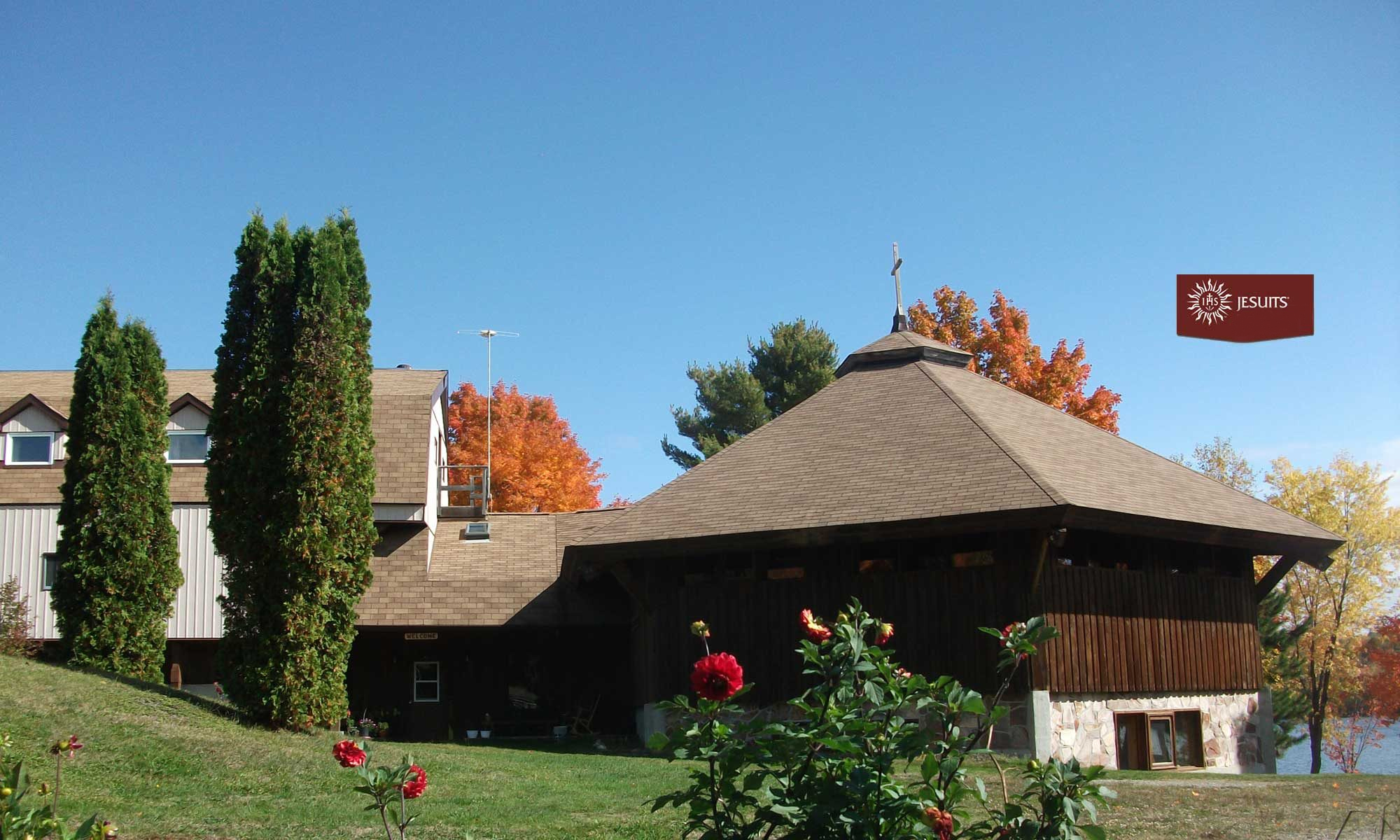

Wasseaandimikaaning – A place of enlightment for spiritual nourishment, growth and healing
By Fr. Paul Robson sj
This Sunday, the Catholic Church observes the World Day of the Poor. Today is the third such Day, as this yearly observance was started by Pope Francis in 2017.
In Jesus’ parable about the rich man and Lazarus, it is suggested that the poor have received bad things in this life, but will receive good things in the next life. While this is true, there is also a sense in which poor people already have good things in this life. In his message for this year’s World Day of the Poor, Pope Francis quotes Psalm 10. In this psalm, we read: “the helpless commit themselves to you.” If it is the poor, rather than the rich, who turn to God and trust in God, then we can say that it is the poor who
are in the better position.
Furthermore, the Pope and the Psalmist suggest that God wants to alleviate, and is working toward alleviating, the present sufferings of the poor. The poor can hope for God’s help and for better things not only in the next life, but in this one. And one way that God helps the poor in this life is through those who are not poor – those who might help, and spend time with, and love and show respect toward, the poor. Pope Francis writes: “I encourage you to seek, in every poor person whom you encounter, his or her true needs, not to stop at their most obvious material needs, but to discover their inner goodness.”
One further dimension to consider, from the Pope’s message, is the following: “The poor save us because they enable us to encounter the face of Jesus Christ.”
By Fr. Jim Kelly sj
Wow. Were you caught off-guard by the snow on Halloween and usehewung? Most of us were. Traditionally that feast is seen as a time of transition. For one thing, the harvest of autumn vegetables is basically over. A heavy frost will mean squash will be ruined if it it still outside. And all the little insects (and I saw a lot of little bugs earlier last week) are done for if they did not lay their eggs or crawl into the ground. Deer and racoons and all those squirrels have had to make their plans for this time of change, and
they know it.
For so many generations, people have marked this time of transition. Setting the table and welcoming guests at Tusehwung is less common know than in days gone by, but giving out candies to youngsters who come to the door seems more popular than ever. And people buy costumes and plastic decorations like never before. The theme of these decorations is a curious mix of happy innocence–coloured leaves and fairies and little superheroes–and the outright demonic and threatening. This mix also reflects a traditional time of transition; that at this time of year there is an opening between our world and the world of the good and bad spirits, between the living and the dead.
Wonderful, then, to see people in the cemetery on Friday, despite the snow, praying for their loved ones who have died. It is a sign of great faith. Trusting already that God has shown mercy to those who have died we have a confidence that it is good for us to pray that this mission of God be fulfilled and perfected. The beginning of the First Reading at Mass this Sunday is striking. It is from the Book of Wisdom:
“The whole world before you, O Lord,
is like a speck that tips the scales,
and like a drop of morning dew that falls on the ground.
But you are merciful to all, for you can do all things,
and you overlook people’s sins, so that they may repent.”
By Fr. Paul Robson sj
On my mind and in my heart these days is the ongoing scandal and crisis in the Church, related to the abuse of minors by clergy and religious brothers. My reactions to this situation have included feeling disappointed, shocked, confused, humbled, humiliated. It was in this context, with this situation in mind, that I took a look at the readings for today’s Mass.
Our first reading, from the Old Testament, tells us that the Lord God “will listen to the prayer of one who is wronged,” and to the prayer of the widow and the orphan. In the New Testament, we find stories of Jesus siding with those who are being treated badly. Jesus also suffered and became a victim, an innocent victim, and so he can relate quite directly to those who hurt and to those who have been wronged.
In our Gospel reading, we have the story of the Pharisee and the tax collector. The Pharisee is “standing by himself”, he has separated himself from others, and he looks down on others. He can be described as a self-righteous person. The tax collector, on the other hand, makes this simple, humble prayer: “God, be merciful to me, a sinner!” I would say that Church leaders, clergy members, like myself, go wrong when we take the position of the Pharisee, and do well when we take the position of the tax collector.
There is hope because God is still working, because Jesus is still working: working toward the healing of the victim and toward changing the heart of the oppressor. For me, among my reactions, noted above, were humility and humiliation. Well, I will take the humility, seeing it as a good thing, as a gift from God, which will help me in my ministry.
By Paul Robson sj
In his first letter to Timothy, Saint Paul encourages prayers for “all who are in high positions, so that we may lead a quiet and peaceable life in all godliness and dignity.” Among those in high positions, we might consider political leaders. On the level of the nation of Canada, an election has been called and will take place on October 21 st . We might pray for the current and future leaders of Canada. We might also begin to consider who we want to vote for next month.
The Canadian Conference of Catholic Bishops (CCCB) has issued a document titled Voting as Catholics: 2019 Federal Election Guide. This guide does not recommend that the Catholic reader should vote for any particular party or candidate. It does mention some principles which the voter can keep in mind while considering the platforms of the different parties.
One of the principles mentioned in the guide is that we, and our leaders, should be “always concerned for the weakest among us – physically, economically, and socially.” This principle, which could also be called the “preferential option for the poor”, is seen in our first reading of today, from the prophet Amos. The prophet has some strong words for those who “trample on the needy, and bring to ruin the poor of the land.”
Besides poor and needy people, something else that gets trampled on at times is Mother Earth. Another point made by the CCCB guide is that we, including our political leaders, should “respect the planet, our common home.”
Let us pray for the poor, and for the Creation, and for political leaders. May we also live in solidarity with poor and needy people, and with all of God’s Creation; and let us encourage our leaders to do likewise.
Father Doug McCarthy died suddenly on the afternoon of 24 August at Our Lady of Lourdes Parish in Toronto. He was in his 75th year and in religious life for 57 years. Doug, the son of Stephen McCarthy and Anna English, was born in Chatham, New Brunswick on 10 September, 1944. After high school he entered the Society at Guelph on 14 august 1962. Two years later he pronounced first vows on 15 August,1964. After juniorate he went in 1966 to Mount St. Michael’s in Spokane for philosophy. His regency took place at St. Paul’s High School, Winnipeg, from 1968 to 1970. He moved to Toronto for theology at Regis College, Willowdale, from 1970 to 1974. His ordination took place at Regis on 9 June, 1973.
Doug began his priestly life at Ignatius College, Guelph where he spent eighteen years. For ten years (1974 to 1984) he was prison chaplain at the Guelph Reformatory. This suited him well as he exhibited a life-long compassion and concern for the underdog – the poor and homeless people, the marginalized and rejected ones. During this time, he was socius to the Master of Novices (1974 – 76) and Director of the “Red House” (1977 – 80). This was a half-way house where former inmates and fragile and wounded souls formed community with volunteers, with members of the Jesuit Companions Program and with a few Jesuits. Under his direction it became the “Farm Community” (1980 – 87). This project utilized the extensive garden plots and fields where members of the Red House and others worked the land and cared for the farm animals. Doug was appointed Director of Novices in 1983. From this time until 1992 when he left Guelph, he had a significant role in the formation of a generation of Jesuits in our Province.
A move to Pickering brought Doug to Manresa Retreat House where he engaged in the Spiritual Exercises apostolate and also preached retreats from 1992-93. From 1993-99 while still giving Manresa retreats, Doug also lived and worked in a downtown Toronto L’Arche home. Like his work with the poor, the neglected and the dying in Calcutta, where Doug assisted Brother Bob Mittelholz, SJ during the summer of 1972, L’Arche had a profound influence on Doug’s thought and style of life. This may have also prepared him for a completely different ministry which began in 1999, when Doug was assigned to Holy Cross Mission in Wikwemikong on Manitoulin Island. Doug was very happy during his thirteen years in Wikwemikong. There he was the pastor of all four of its churches, Superior of the community of five Jesuits for a time, and so respected and loved by the Indigenous people among whom he was so very inculturated, that they gave him an Indian name – Minowadjmod, “the carrier of the message, always a good message”. Beginning in 2012, Doug was an Associate Pastor at Our Lady of Lourdes Parish, Toronto, where he also helped the Red Cross serve the poor and homeless, where he helped with the All Inclusive Ministries, and where he was always eager to help the many vulnerable people who so often came to the door. Doug was a moving preacher, and people drove across the city just to hear his brief but stirring homilies.
Occasionally Doug would compose articles for the Jesuit Province blog igNation and invariably he wrote about various people he met in the parish precincts – the homeless, beggars, refugees, and the dispossessed of mind and soul. In January of this year he fell on ice while trying to fill his bird feeder and suffered a severe fracture of his ankle. This resulted in surgery and many months of recuperation at René Goupil in Pickering before he was able to walk and so return to Lourdes.
In recent years Doug struggled with personal demons. It was never easy, and like Jesus, he fell a number of times. But with the help of the Society and of good friends, he always got up to resume the priestly ministry which was so much part of who he was.
WAKE
Friday, August 30 (Our Lady of Lourdes Church, Toronto)
11:00 am to 9:00pm Visitation
7:30pm Prayer Service
FUNERAL
Saturday, August 31 (Our Lady of Lourdes Church, Toronto)
9:30am Funeral Mass
11:00am Reception (Our Lady of Lourdes Garden)
BURIAL
Saturday, August 31 (Jesuit Cemetery, Guelph)
2:00pm Rite of Committal
Reception at Loyola House
By Paul Robson sj
I once read a book which told the story of a boy who was in a kind of military space camp. This boy often played a video game. In the game, there were different games within the larger game. As the character in the video game moved along a path, that character could see hints of different games to the left or to the right, games which he could play if he left the path. The boy realized that these smaller games might be fun but would be distractions, and that he should stay on the main path.
Today’s second reading speaks about “straight paths for your feet”. Like the boy playing the video game, we are called to stay on the straight path, the main path, the path of goodness and of God’s will for us, as we journey through life.
Similar to the image of the straight path, the Gospel reading talks about entering through “the narrow door”. If the door is narrow, then it is not easy to get through. It is also difficult for us to stay on the straight path in our lives. It is difficult, maybe even impossible, on our own. But for God all things are possible. Through prayer and through God’s grace, we can stay on the straight path in our life’s journey, and we can return to that path when we have left it. God can make that journey on the straight path not only possible, but easy and pleasant and joyful!
Also, a sure-fire way to get off the straight path is to be overly confident that you are on that straight path. In today’s Gospel, Jesus challenges certain people, people who might see themselves as being on the “inside” or on the straight and narrow path. He tells them to be careful lest they find themselves on the outside.
Let us pray that we might make, and that God might make, straight paths for our feet as we continue this journey together.
By Fr. Paul Robson sj
Happy feast of Saint Ignatius! (Almost! We can celebrate this Wednesday, July 31 st .)
Ignatius (or Iñigo) was born in Loyola, Spain, in 1491. He had a spiritual conversion experience at the age of 29 or 30, while lying in bed after a cannonball had shattered his leg. Later, he and his companions formed the Society of Jesus, which was approved by Pope Paul III in 1540. Ignatius became the new religious order’s first Superior General. He died in Rome on July 31, 1556, and was canonized a saint in 1622.
In Ignatius’ autobiography, concerning the conversion experience after the cannonball injury, we read the following: “Little by little he came to recognize the difference between the spirits that agitated him, one from the demon, the other from God.” Similarly, in the Spiritual Exercises, he writes about movements that arise in one’s soul – and some of these movements come from the good spirit, some from the evil spirit. Ignatius wrote down some rules “for recognizing those [movements] that are good to admit them, and those that are bad, to reject them.” Let us pray that we might live lives which follow the promptings of the good spirit, and not those of the evil spirit.
Here in Wiikwemkoong, and around much of Manitoulin and the North Shore, our Catholic parishes can be considered Jesuit parishes, under the patronage and protection of St. Ignatius. St. Ignatius, guide us and pray for us!
Role and Commitment of the Disciple
By Rosella Kinoshameg DOS
Luke’s gospel tells us about Jesus’ beginning journey to Jerusalem, “set his face” means with resolve and single minded purpose, to fulfill his destiny – to his eventual crucifixion and resurrection.
Jesus did not travel alone, and as he travels, he teaches as he leads his followers. James and John, the same disciples who asked to sit at Jesus's right and left (i.e., next in command), wanted to call divine wrath on the Samaritan village. In rebuking them, Jesus teaches a very important lesson by demonstrating love, not vengeance, towards
the Samaritans.
Jesus’ words sound harsh to potential followers but his words make an important point about discipleship. The journey with him is not an easy one. Jesus says to go and proclaim the kingdom of God. This is our Christian vocation and must be our first priority.
There is uncertainty, but we must trust God to provide and not worry about needs, keep our focus. “The Son of God has nowhere to lay his head” means this is a mobile ministry. Discipleship requires a clear understanding of our role and commitment: to serve, and to trust in the Lord is the highest priority.
Let us pray and ask God for strength to accept his invitation to follow. As the journey will not be easy, let the Holy Spirit be our guide to keep us focused on our journey and the importance of love, so that we will come closer to God.
By Paul Robson sj
Today we celebrate the Feast, or the Solemnity, of the Body and Blood of Christ. Considering that this is our focus, what Gospel reading do you think would be the most appropriate for today’s Mass?
The story of the Last Supper might come to mind. On that occasion, gathered around the table with his disciples, Jesus took the bread and blessed it and broke it, and said, “This is my body…” We do what they
did, and receive the Body and Blood of Jesus, when we gather for Mass.
That Last Supper story would indeed be a good Gospel reading for today. However, the Gospel that we read and hear today is not that one, but is the story sometimes referred to as “the feeding of the five thousand”. This passage about the five thousand might be less of an obvious choice than the Last Supper, for today’s Feast. Upon further reflection, though, it too is appropriate.
In the story of the feeding of the five thousand, the people receive a great gift and blessing from Jesus. He blesses a small amount of bread and fish, and somehow, miraculously, a great crowd is fed. We might say that Jesus is doing most of the work here, and he is; but there is also participation from
others, who bring the bit of food that is available, and who help to distribute the bread and the fish.
Something similar happens when we celebrate the Eucharist. We receive a great gift, but our participation is also important. God takes our small offerings of bread and wine, and transforms them. Likewise God takes our small offerings of our selves, of our hearts, and transforms us.
Let us pray that we might be open today to receiving this great gift, the gift of Jesus.