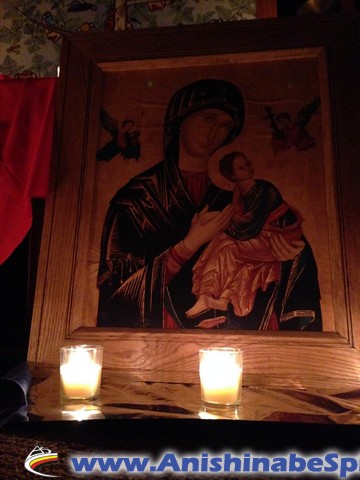
National Day of Prayer in Solidarity with the Indigenous People

Homily from Fr. Teo Ugaban:

In this feast of St. Lucy, a martyr we are encouraged to examine the word “solidarity”. This month, we are also praying for communities of Native and Indigenous peoples. In these occasions, perhaps we can also take the time to ponder “solidarity” as part of our vocation, as part of Christian participation.

We hear too often the word solidarity, but have we spent the time in prayer and reflection on how we participate in the works and lives of others. Of course, I make the assumption that prayer and action must always work together.

To be in solidarity goes beyond the language of awareness, to be aware of something can set us up as visual spectators; we may hear and see the troubles that besiege a particular person or community, but do we dare take the next step > the one that leads us into action.

Christian participation is not about being a spectator, rather the events and situations that affect others must have an impact on how we relate to the marginalized, to victims of violence and to persons and communities that have been historically subjected to injustice and prejudice.

The readings for today, especially the Gospel, encourages us to become more attentive to the world around us, we are invited, especially in this Advent season, to witness how God, time and again breaks into the world.

To be in solidarity can also mean that in our awareness and attentiveness, we find the time to discern our place in a particular situation; discernment is not just about making a sound decision, rather it is about making a responsible series of choices that leads a person to grow in their relationship with others; discernment ultimately flows out from our “being” so that we can contribute to the flourishing of other persons and communities.

If we are to be in solidarity with others > prayer is important this is non-negotiable; we need to be attentive > we open ourselves to the act of listening; finally, to be in solidarity means that we exercise our sense of humility – knowing how we can make ourselves available to serving others and knowing the limits of our own generosity. Solidarity is not a performance, rather it is a response that comes from our experience of freedom.

Solidarity ultimately calls of us to respond out of a deeper sense of freedom, a freedom that is modeled upon the life of Jesus Christ. Amen.


Teo Ugaban, SJ

Anishinabe Spirituality Centre

Espanola, Ontario


Congratulations to Debra Ense

December 1st 2013 – Immaculate Conception Parish – M´Chigeeng

Celebrating the Mandating of Debra Ense to the Diocesan Order of Service.

IMG_0223 thumb640x480 IMG_0229 thumb640x480

Bishop Jean-Louis Plouffe with members of the Diocesan Order of Service .


Arthur, french student biking from Vancouver to Montreal

arthur-guillemotI am a French student in a mechanical engineering school in Lille (north of France) named ICAM (Institut Catholique d’Arts et Métiers). ICAM was built in 1898 by manufacturers and Jesuits in order to form engineers in the industrial sector, sensitive to social justice. Nowadays it is still a school directed by Jesuits. Students join the school after the “baccalauréat” for 5 years of studies. Between the 3rd and 4th year we have the opportunity to carry out a 4 month individual project usually called “experiment”.

For my “experiment”, I have chosen to cross Canada by bike! I can briefly explain how I came to this decision.

I wanted to do something sporty and discover a country composed of several amazing landscapes. I was looking for a way of travelling that facilitates contact with local inhabitants. At first I thought of running because I love running but it was not convenient at all for my luggage! With a bike I can do longer distances and discover more landscape! I like to excel myself physically and mentally even though the first goal is to meet new people and discover Canada.

I started my trip in Vancouver. I arrived there the 10th of June and have been hosted by the Jesuit communities. I spent few days in Vancouver in order to reassemble my bike, check all my equipment and visit the city. I left Vancouver the 13th. I have reached the Rockies quite fast and started to meet people on my way. I was pretty satisfied because my “experiment”was going as I expected and I have found that people around me were very generous. It makes me feel confident for the rest of the trip.

Some days in the rockies were quite hard especially that I was not trained at all. Nevertheless the kindness of people I met gave me strength to go on. I was biking for 70kms a day but once I have reached the prairies I was biking for 90-100kms a day.

After 23 days in the Rockies, I arrived in Calgary. It was the beginning of the prairies. Going through the prairies was not so boring. The immensity of the land was impressive but what I will always remember is the bad weather. I have been through lots of rain, storm even tornado watch. Of course I have experienced the head wind several time and without any doubt that the worst thing for a cyclist.

10 days after leaving Calgary, I arrived in Regina. There I have stayed in the Jesuits community. It was a great opportunity to rest and try to re-gain the weight that I had lost. After almost one week in Regina, I had to hit the road again. to Winnipeg.

It took me 7 days to reach Winnipeg. Even though the road was very flat the weather made it hard. Hopefully Canadian were here to help me, inviting me for supper or to stay in their house.

Finally I arrived in Ontario and all his lakes. I have been through Kenora, Fort Frances and then Thunder Bay. The road was gorgeous. 

Between Thunder Bay and Sault St Marie I had to deal with big hills. Of course they are shorter than the one in B.C but they are way stepper. It was pretty hard physically because of the hills but also the temperatures at night were very low. However it is probably the part of the trip that I have preferred. Following lake Superior was just amazing.

Since I passed Sault St Marie the road are flatter so a little bit less interesting.

I have arrived in Espanola the 19th of August and I was glad to be able to stay at the retreat center because I really needed some rest. I have been very well welcomed and the staff made me feel at home.The simplicity and the beauty of the place was all I needed (and even more) to rest and have time to think about my trip. It was a peaceful time to remind me the simplicity of the relations I had with the people I have met on my journey. For on time I was able to see the nature from a lake and not from a road… I enjoyed the silence. I have spent some really nice evenings with David Shulist and Howard sharing about our own experiences. I would like to thank all the staff who give me the opportunity to stay at the center, for their hospitality and their generosity.

I have done about 4200kms and still 1000kms to go. I have enjoyed my trip so far. I am very sensible and grateful for the generosity and the kindness of people I have met on the road. Without all of them, my journey would have been way much more difficult. 

arthur-guillemot-600px

Statement of Reconciliation – The Jesuits in English Canada

Father Winston Rye, SJ
The Jesuits in English Canada
Truth & Reconciliation Commission
Québec National Event, Montréal, April 25, 2013


Let me begin today by first acknowledging all Survivors of the Residential Schools and their families, the Elders present, the Commissioners, Church and community leaders and members of the wider communities. We thank you sincerely for the invitation to share in this important event.

The Jesuits in English Canada want to take this special occasion to honour the Survivors. It has taken great courage, strength and generosity for you to come forward and to share your story with all of us here, a story of loss, grief, hardship, but also of resistance and healing.

We also greet the children and grandchildren of the Survivors, who suffered in turn from their parent’s trauma in the Residential Schools and learned from their character and bravery.

We come today to pay tribute to the individuals who attended the Spanish Residential School; both boys and girls. We recognize and embrace the students who attended the St.
Peter Claver Residential School for Boys, St. Charles Garnier Collegiate and St. Joseph’s School for Girls, some of whom are with us today in the audience.

This gathering is a symbol of hope and a reminder to all of us that such abuse must never happen again.

I stand here on behalf of the Jesuits to say that we are truly, deep within our hearts, sorry for what we did to injure individuals, families and communities by participating in the Canadian Residential School system.

When the Jesuits first met with First Nations peoples 400 years ago, we recognized the greatness of your traditional spiritual beliefs. That openness was lost in the 20th Century.
The legacy of the Residential Schools is a terrible cloud on our legacy of friendship. Today, we are relearning how to trust each other in a deeper understanding of our own faith through the lessons that your Elders have taught us.

It has been a struggle for the Jesuits to recognize that we became an active part of a system aimed at the assimilation of your traditional culture. It was not until it was much too late that we realized the harm that we had done.

The Jesuits are proud to still count many of our former students as friends and colleagues. We are grateful for the forgiveness and understanding that you have extended to us over the years. We humbly thank you for sticking with us and continuing to welcome us in your homes and communities.

We come to celebrate the achievements of our students. We recognize that what they achieved as professionals, athletes and community leaders was not because of our efforts at the school – but through their own strength of character and love of knowledge.

We also come to acknowledge the students who were brave enough to confront us about our role in the Residential School system some thirty years ago. We treated you as dissenters and malcontents rather than listening to what you had to tell us.

Through litigation and lawsuits, we learned about harsh conditions, poor food, brutal punishment and horrible incidents of sexual molestation. You turned to the courts because the Jesuits turned away from you.

As educators, we have been shocked by stories of bullying, inadequate clothing, strapping and beatings for minor offences. Our School harboured individuals who molested or abused students. Bed wetters were tormented by older students and staff alike. The food was not fit for the needs of growing boys and girls.

Children who were much too young were taken from the love of their families and placed under the guidance of men and women who had little training and less compassion. Most of all, we have heard stories of the inherent unfairness of the system. Students were given the strap for things that they did not do. Bullies were rewarded and victims punished. Abuse
was not disclosed because there was no one who would hear a student’s cry for help.

We are still struggling with how it could possibly have happened. We realize that the abuse might have been uncovered and punished many years ago, if there had been someone that
the students could turn to. We failed in putting the needs and interests of the Jesuit priests and brothers ahead of the welfare of our students.

We vow that this will never be “the way things are” ever again. Amongst the heartache, we have delighted in stories about how students outwitted their teachers and kept their spirit alive through practical jokes and ingenuity. Our students understood their instructors and their human frailties so much better than their teachers understood them. They fought against the unfairness of the system with humour and good nature.

We have heard of brave students who were resourceful enough to set out for their home communities. We are ashamed of the harsh punishments that they received when they were brought back by the authorities.

We offer a sincere prayer of thankfulness that no young lives were lost at our school because students ran away.

We have learned from these harsh lessons and have become stronger from your example. To the students who have defended us and taken our part, we are truly grateful. We will
strive to prove ourselves worthy of the respect and love that you have shown your teachers.

We are deeply grateful to the communities that have continued to welcome us as pastors and as friends in the years since the Spanish Residential Schools closed.

We are humbled by your love and forgiveness. We have never had to beg for reconciliation; you have offered it to us freely for so many years by your example.

We ask for your forgiveness for any role that our school may have played in sowing distrust and division between Catholic and Protestant families. It is not enough to decry the narrow
mindedness of the times. By teaching intolerance in our schools, we sowed division where it had never existed.

Many of you have asked when the reconciliation between the churches will occur. We desire and pray that it is happening today as we move together in healing with our friends in the Ecumenical Working Group.

Finally, we have learned of the terrible inequality that continues to exist between the educational opportunities for white students and students from First Nations in Canada. Young people are still being transported to white communities, to obtain an education in an environment that is foreign to them. This is exactly what happened in the past and we seem to be reliving it again.

We share Shannen Koostachin’s dream that in our lifetime we will see equal opportunities for education in the home community of every Canadian. We will do everything in our
power and influence to ensure that this comes to pass and the injustices of the past are not perpetuated.

You had the courage to stand up and speak out about the past. You can help us all to open our minds and our hearts to understand and to stop the destruction now and not have to go
through this all over again.

Today we stand before you to pledge our support in the rebuilding of your language and culture. We cannot undo the things that are done, but we can take positive and meaningful
steps to rebuild.

We have opened our Archives so that the whole picture of the Residential Schools can be seen.

We will unlock the doors to the ancient books that preserved the languages of the First Nations and make copies available to people in their own communities.

These precious resources will never again be the exclusive property of white scholars and academics.

We thank the Commissioners for challenging us to undertake this journey of self-examination and reflection with them. We will work hand in hand with our students past and present to bring all these things to pass.

May the Creator God who sees all and knows what is truly in our hearts, bring us together. May the Blessed Kateri Tekakwitha guide us that we can learn from each other, for she
is a model for us all.

May we come once again to call each other “friend”.


Authors
Father Peter Bisson, SJ, Provincial
Father Winston Rye, SJ
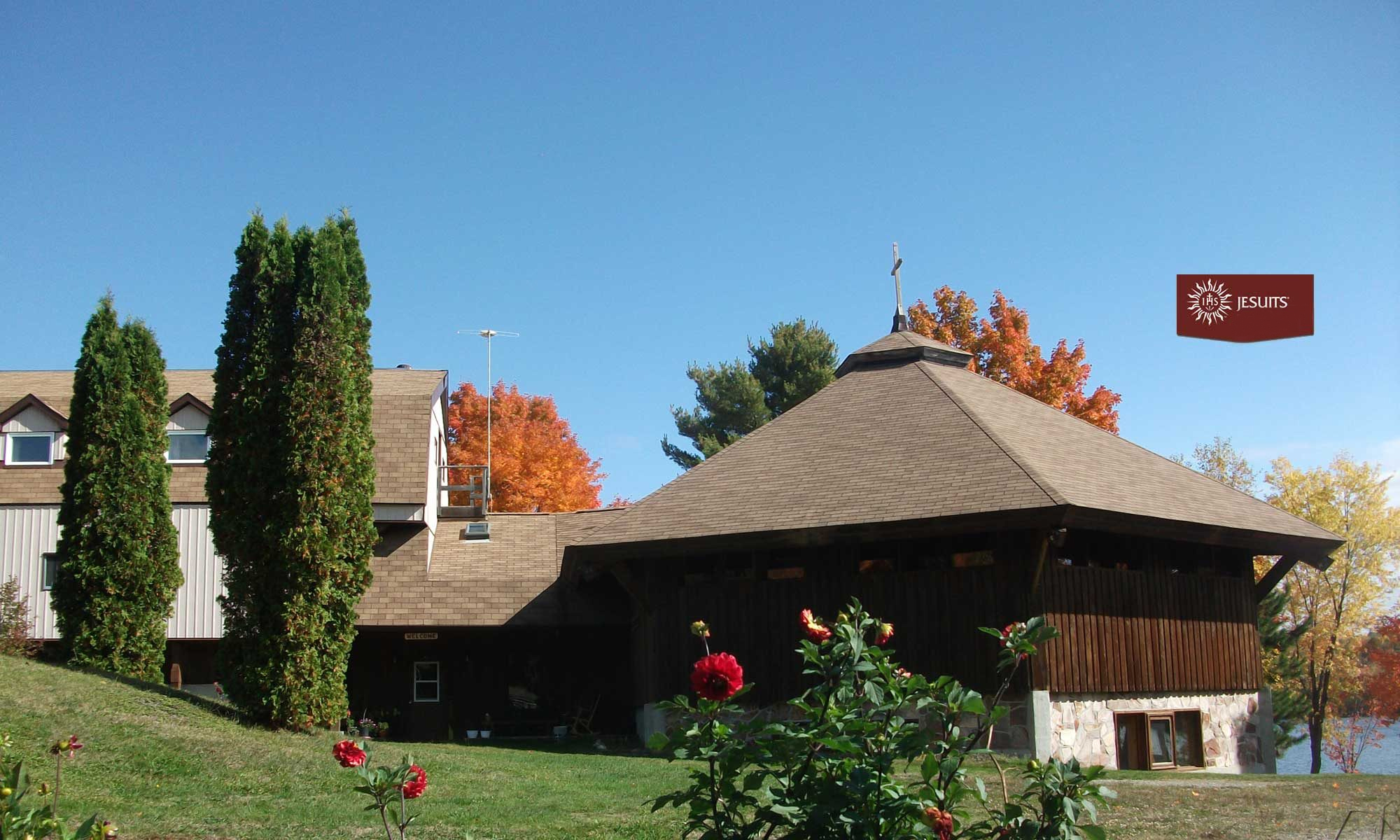
Feast of St. Ignatius at Anishinabe Spiritual Centre – July 31st – Espanola, ON

On July 31st, the Anishinabe Spiritual Centre celebrated the Feast of St. Ignatius with friends from Sagamok, Cutler, M’Chigeeng, Birch Island and Richmond Hill (Toronto). 

The liturgy was celebrated by Fr. Teo Ugaban, SJ and music ministry was provided by Fr. David Norris, SJ. 

The barbecue supper was hosted by Fr. Teo, Arturo Garcia, Bro. Howard Tu, SJ (Taiwan) and Mme. Louise Gagnon.

IMG_1811 thumb640x480

IMG_1813 thumb640x480 IMG_1814 thumb640x480 IMG_1815 thumb640x480 IMG_1817 thumb640x480 IMG_1819 thumb640x480

Awed by the beauty of God´s country – by Rob O´Flanagan

Jul 06, 2013

Awed in God’s country

Source: http://www.guelphmercury.com/opinion-story/3881011-awed-in-god-s-country/

There is a small place on the north shore region of Georgian Bay/Lake Huron that, there can be no doubt, is God’s country.

You can get there by ferry or you can drive over Georgian Bay. One way or the other, it’s about five or six hours from here.

I remain awed by the La Cloche Mountain region around Whitefish Falls and Willisville, just a few minutes south of Espanola. I’ve been going in there for nearly 20 years, mostly to be dumbstruck. Because of its relative inaccessibility there are hardly any human beings around.

Every time I’m in there I feel a peculiar sense of disembodiment, like I’m not really there, can’t possibly be there in such an inspiring and beautiful place. Those pinkish white hills are about 3.5 billion years old, remnants of one of the oldest, and once tallest mountain ranges on Earth.

I like to hike up high, up onto the white quartzite ledges where the view goes on for 30, maybe 40 kilometres in all directions—where the sight is almost too much to absorb for one feeble little man.

Usually, I have a notion to capture a snapshot of this intense beauty with a graphite pencil, a watercolour set or a box of oil pastels. That effort is always on the lamentable side. I’m no Franklin Carmichael, but I think I understand the great painter’s love of La Cloche.

That’s what I tried to do last week when I was up in La Cloche country on a rendezvous/retreat with my wife. Valerie is in rehearsals for a stage production of The Monument in Sudbury. She had some down time and I had some vacation time, so we rented a cabin at a Jesuit-run place called Anishinabe Spiritual Centre and had one of the finest times of our 30 years together. She remains a world-leading rummy player.

I spent one afternoon on my own up in the hills above Willisville, gazing out at Manitoulin Island in the distance to the south, Bay of Islands to the southwest, the Grace Lake hills to the east, and the stinky pulp mill in Espanola to the north. It was jaw-dropping as usual, with the rapidly changing skies and the perpetual shifting of shadows over the hills and forest. You have to be fast on the draw with your drawing pencil.

I did a number of small sketches and a large oil pastel sketch on paper up on a white slope, scorching hot and breathtaking—all views of Cranberry Bay, one of my favourite canoe routes of all canoe routes.

There are many places that fill us with awe, all over the world, close to home and far away. The mountains of Lesotho, the Great Wall of China, the cavity where once the World Trade Center stood, the birthplace of James Joyce, the Ring of Kerry. These are some of those places on Earth for me—unbelievable places.

But such locales don’t have to be epic in terms of their historical significance or natural beauty. They can be epic because of their personal association.

A couple of weeks ago I was in Rogers Centre in Toronto watching a Blue Jays game with my brother, Patrick, his wife, Deanna, and several members of her family that had driven down from Temiskaming.

At one point, Pat and I stood up to troll for food and memorabilia, and I said to him: “You know that feeling you get when you can’t quite believe you’re actually doing something or actually in a place?” And he said, “Oh ya, do I ever.” And I said, “I’ve got that feeling right now.”

There we were, together after many years of living about 4,000 kilometres apart, in muggy Toronto watching a big league baseball game. It seemed too impossible to be real, like being up high in the La Cloche range, or being on a remote retreat with your significant others, far from routine life circumstances. Is this really happening?

Certain places, certain experiences confirm that life is a series of mysteries, enigmas, and wonders that together add up to a disorienting sense of being displaced, disembodied and in awe. That’s the beauty of it.

Rob O’Flanagan is a Mercury staff writer. His Free Form column appears Saturdays. He can be reached atroflanagan@guelphmercury.com

Anishinabe Spiritual Centre honours National Aboriginal Day, June 21, 2013

On June 21st, honour National Aboriginal Day with us at Anishinabe Spiritual Centre.

The Canadian Parliament designated the summer solstice – the first day of summer and the longest day of the year – as a day to commemorate the vast and rich contributions of Canada’s Aboriginal Peoples. This day, celebrated since 1996, is honoured with events from coast to coast to coast to recognize the essential role of Canada’s diverse Aboriginal Peoples.

We are deeply privileged to live and work among First Nations people here at the Centre and, while we want to be aware of our Aboriginal Peoples every day, June 21st will be a special recognition of the many gifts Aboriginal Peoples bring to us here, and to each of us as Canadians, as well as the many challenges they face to receive proper recognition and restitution.

Canada’s National Aboriginal Day each June 21st is annually held to celebrate the unique heritage, diverse cultures, and outstanding achievements of the nation’s Aboriginal peoples (the First Nations, Inuit and Métis peoples).  The importance of this day is not only to identify and pay homage to the social, economic, and political contributions that Aboriginal Peoples have made to the fabric of Canada, but it is, at the very least, equally as important to recognize the historical and systemic hardships and exploitation that Aboriginal Peoples have endured during the post-colonial era.

In celebration of National Aboriginal Day, His Excellency the Right Honourable David Johnston, Governor General of Canada, will attend the Summer Solstice Aboriginal Arts Festival’s Education Day Event, on Friday, June 21, 2013 at Vincent Massey Park in Ottawa, delivering brief remarks at 12:10 p.m.

Please also visit:  http://www.aadnc-aandc.gc.ca/eng/1100100013248/1100100013249, the Aboriginal Affairs and Northern Development Canada’s website for this designated day and for ideas on how to honour it. *

We at Anishinabe Spiritual Centre offer prayers for all peoples of Canada, and our hope is to be people who bring peace and greater unity amidst pain and division.  We invite you to join us in this intention.

(* with files from the Government of Canada, Ontario’s Ministry of Aboriginal Affairs and the UFCW)