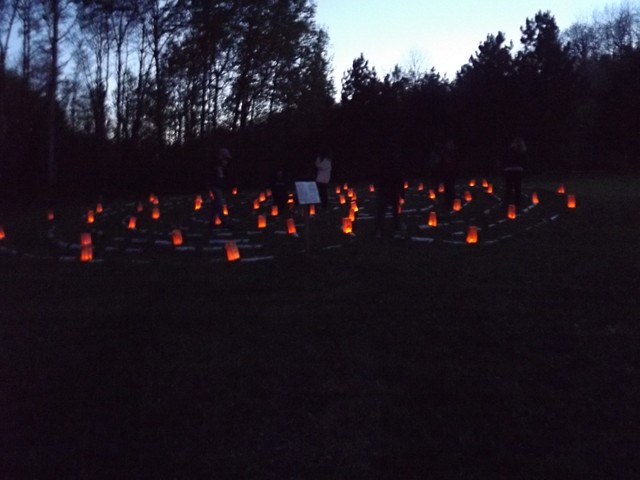
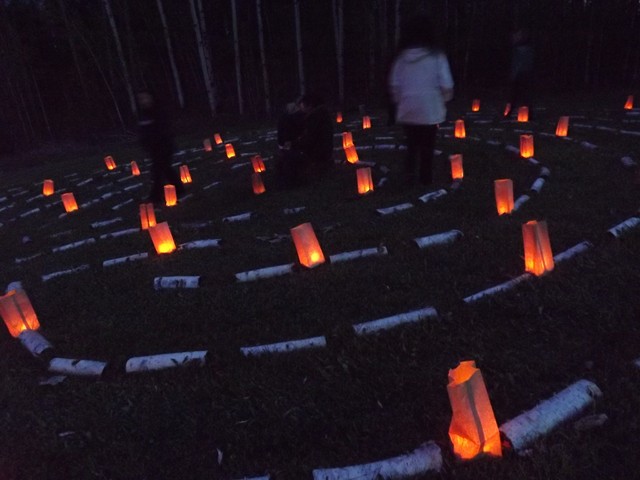
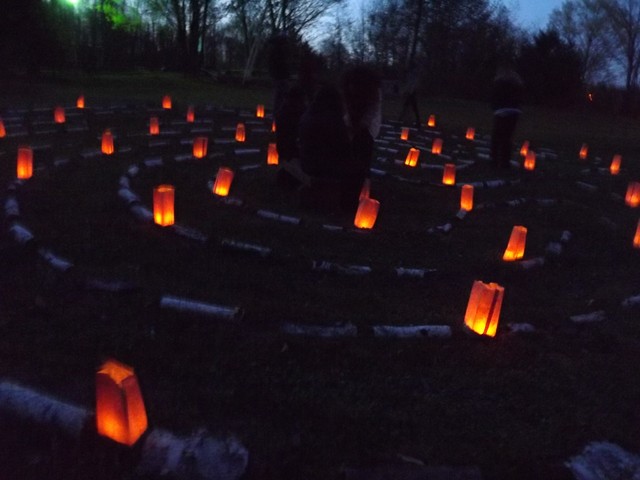
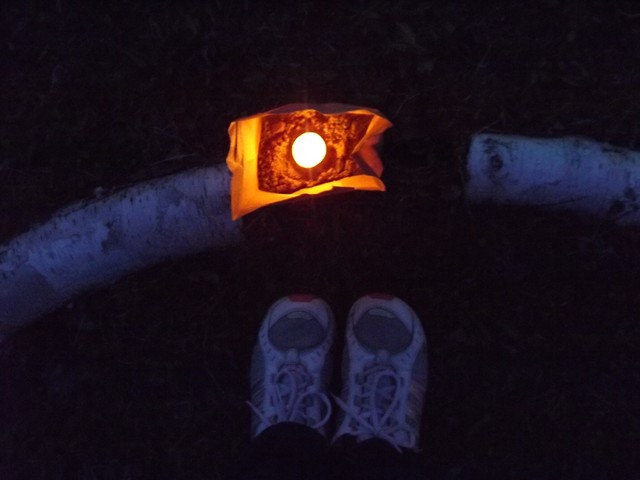
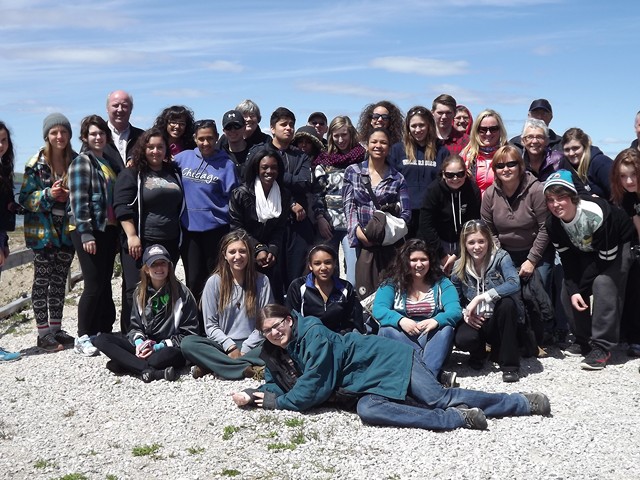
The Anishinabe Spiritual Centre hosted a group organized by “Our Lady of Mt-Carmel” in Toronto, 26 students were part of this program
Thanks to Vasti Darko, a participant of this program who took the following photos, thank you Vasti!
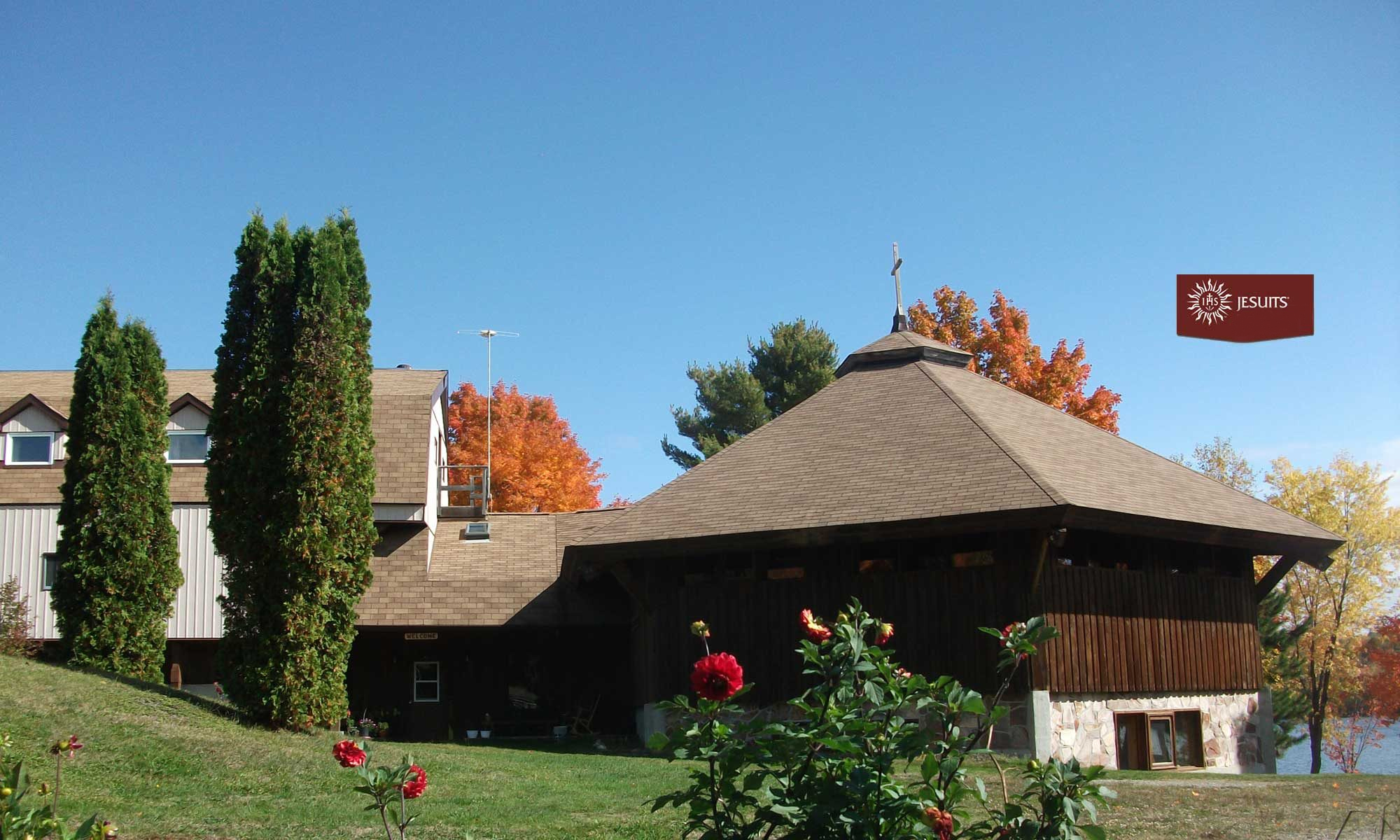

Wasseaandimikaaning – A place of enlightment for spiritual nourishment, growth and healing
Kateri: a bridge between cultures
An interview with David Shulist, S.J.
Pierre Bélanger S.J.: Father David Shulist S.J., you’ve just come home from a canonization
ceremony. What were your first impressions?
David Shulist S.J.: I was amazed at how enthusiastic the crowd was, they sure showed their enthusiasm. The people who were there really wanted to be there, and they were expressing their personal devotion. In the case of Kateri, I was able to see that in many of the pilgrims. But the number of people coming from lots of different countries, where these saints came from, was also striking. There was great excitement in the air and also
the pride of the pilgrms in representing their families, or their communities. What was
happening was real for them. They were aware that history was being made. It was a
historic moment, especially for the First Nations people who had come for Kateri’s
canonization.
PB S.J.: Let’s just talk about Kateri. What were the important aspects of her life, in your
opinion? How are they significant today?
DS S.J.: Here was a young woman who had to make some really difficult decisions in her
life. We know she was 24 when she died. She officially made a commitment to be a
Christian at the age of 20, but you can imagine it wasn’t a decision that was made
overnight. She’d always had a deep spiritual life; she was looking for something more
than the everyday life that people in her community lived, and that’s what opened her up
to Christianity. The first thing I would say, then, is that age is never a barrier when it
comes to committing yourself to Christ. With the lack of interest in the church among
young people, we can be tempted to think that Christianity is just for older people, who
need to believe in something greater than their own personal achievements. But Kateri
shows us that in every era, in hers just as in ours, people can grow spiritually, and age
isn’t a barrier.
The most important aspect of Kateri’s life is perhaps that she was a woman who knew
and understood what we call today “the paschal mystery” – because she lived it herself.
She knew suffering, she’d learned what it meant to go through suffering and to be reborn
out of suffering and enter a new world. How? In particular in her decision to transplant
herself into a new environment. She left a community, that of her uncle, and moved into
another vocation, another community.
In a sense, she is a concrete example of what happens to us when we let the Holy Spirit
guide us, and respond to that call. It’s an expression of our true freedom, in the Ignatian
sense of the term, which means the freedom not to be controlled by the demands of some
of our present relationships or even by what is considered most important in our culture.
And if we can find meaning in that different choice, even without seeing it clearly, that’s
where faith comes into it. So it’s a powerful witness and shows we are capable of saying
“yes.”
As for the resurrection, that’s exactly what happened to her. She became someone who
was turned completely towards God. We might criticize some elements of her devotions from our present-day perspective, but we have to take into account the cultural context of
the time, when people practised their Christianity in a different style.
PB S.J.: Is Kateri an important person for the First Nations communities you work with up in Northern Ontario?
DS S.J.: Yes she is. I’d say that in cultural terms, you can compare her to Our Lady of
Guadeloupe, for Mexicans. Kateri is a powerful figure among the people I work with,
especially for women and above all for mothers and grandmothers.
PB S.J.: Even though she didn’t have any children?
DS S.J.: It’s true she wasn’t a mother, but women feel that Kateri walks on the same path as they do, she prays with them, she comes to them in their dreams. I know a woman called Gerry, and she told me that she’s talked with Kateri as if she was right there, in person, in front of her. It wasn’t the expression of some fantasy. It was a real experience. Gerry is in a mixed marriage, she’s married to a man from another community, like Kateri’s mother was. So she sees Kateri as a sort of guide, an advisor, the person she meets with to pray.
I make the comparison with a prayer St. Ignatius’ calls the colloquy, where we imagine
we are in conversation with Mary, and with Jesus, at the heart of our prayer. I recognize
the authenticity of her experience because Gerry is known for the discreet quality of her
prayer. People come and ask her for advice, and the intuitions she has about how to help
people, she says, are due to Kateri’s presence in her life. This relationship with Kateri
must be authentic because it produces fruit. I’ve heard women say that it’s thanks to the
intercession of Kateri that they’ve had a child, or that people they know have stopped
taking drugs, or that family conflicts have been healed.
PB S.J.: Could the fact that the community with whom you live does not belong to the same
community or First Nation as Kateri have been a barrier to accepting her or recognizing
her influence?
DS S.J.: In fact the people up here talk about her as anishnabe and as a First Nations person.
They are Ojibwe and she was Algonquin and Mohawk, but that doesn’t seem to be a
problem.
PB S.J.: Can you see the influence of the Jesuits, whom Kateri knew in her first community
as well as on the shores of the St. Lawrence? Are we talking about a “Jesuit saint”?
DS S.J.: In a way I don’t think Kateri was close enough to the community [the Jesuits] that
we can call her that, but the role she is playing in our time, both in the personal lives of
people and in the life of the Church, is close to what the Jesuits understand as sanctity.
She is an important bridge between cultures, at a time when the Jesuits are interested in
reaching across cultures and religions. She was a woman who was able to position herself
between different cultures. In fact she holds a fascination for both indigenous and nonindigenous peoples. PB: Is building bridges like this one of the roles of the Society of Jesus?
DS S.J.: That’s right. Although she was a woman of her own world and her own time,
Kateri’s example transcends historic circumstances. When you think of our spirituality as
Jesuits, we are called to live in this world, at the heart of human reality. Even though we
each come from a specific cultural context, we are invited to live in other contexts so that
we can become witnesses to the presence of Christ. When you look at Kateri’s
spirituality, she was centred on Jesus, just as Saint Ignatius was. Kateri was deeply
affected by the life of Christ who suffered and was sacrificed for us. It’s very meaningful.
I’d also add that Kateri was given by God to her people, to her family, but also to others,
to the other community in which she went to live. She died, but today, with the event of
her canonization, God is giving her to us again, she is given to the world of our own time.
Canonization is a celebration of the gift that God has given us.
PB S.J.: Is that the significance of this celebration that you’ll take back to the people of
Manitoulin?
DS S.J.: Yes. The canonization of Kateri signifies that the love of God is alive and active, that God stays in relationship with us, and that the love of God has come near, it is real, through her. I think also that this event brings us much hope, the hope of seeing Canada as country that is alive, more human, a symbol for the world that a great diversity of people can live together and live in peace.
Photo captions:
1. Crowd celebrating the canonization of Kateri, October 21, 2012
2. The assembled pilgrims in St. Peter’s Square during the canonizations
3. Fr. David Shulist S.J.

Catholic Education Week will be held this year from May 5-12, 2013. This year, the theme for Catholic Education week for the Huron-Superior Catholic District School Board is “Growing Together in Faith”, which is a nice alignment with the Church’s theme of the Year of Faith.
Education Week is a great opportunity to show our appreciation to all involved in our Catholic schools.
+Jean-Louis Plouffe – Bishop of Sault Ste. Marie
For more information:
Ask for the light of the Holy Spirit to see through God’s eyes
-John Veltri SJ (adapted)
Prayer for Humility
Let me have too deep a sense of humor ever to be proud.
Let me know my absurdity before I act absurdly.
Let me realize that when I am humble I am most human,
most truthful,
and most worthy of your serious consideration.
-Daniel A. Lord SJ
Daniel lord (1888-1955) was an indefatigable pamphleteer who was also
well known for his work with youth.
I beg of you, my Lord,
to remove anything which separates
me from you, and you from me.
Remove anything that makes me unworthy
of your sight, your control, your reprehension;
of your speech and conversation,
of your benevolence and love.
Cast from me every evil
that stands in the way of my seeing you,
hearing, tasting, savoring, and touching you;
fearing and being mindful of you;
knowing, trusting, loving, and possessing you; I
being conscious of your presence
and, as far as may be, enjoying you.
This is what I ask for myself
and earnestly desire from you. Amen.
-Blessed Peter Faber S]
Peter Faber (1506-46) was one of the original companions of St. Ignatius.
Ignatius considered Faber most gifted in directing the spiritual exercises.