Jesuits participate in residential school gathering

residential-school-gathering

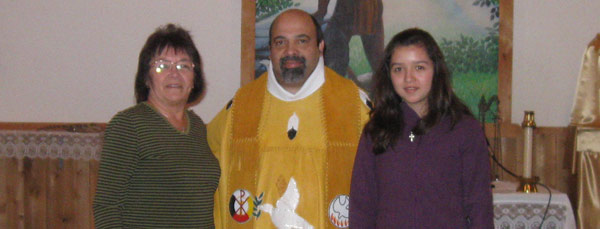
                This past March 9th to 11th, 2012, Spanish, Ontario was host to the St. Charles Garnier & St. Joseph’s Residential School Gathering. St. Charles Garnier was the boys’ school in Spanish, which was owned and operated by the Jesuits between 1913 and 1958. One of the organizers of the reunion was Pauline Toulouse, a member of the Diocesan Order of Service (DOS) and participant in the Anishinabe Spiritual Centre’s Ministries Programme. Fr. David Shulist SJ and Paul Robson SJ attended and participated in the event, as did Justin Dittrick, a Jesuit Volunteer. Fr. David celebrated the Mass on Sunday, and Paul helped design the program for the event.

The theme for the weekend was “Remembering the Good Times”, and there was a spirit of positivity and moving forward about the reunion. There was also a spirit of humour, with a performance and workshop by comedian Leonard Dick (“Moccasin Joe”). Speeches by honourary guests mentioned both the bad but also the many good experiences that alumni had had at the schools. Chief Isadore Day of Serpent River First Nation spoke about the necessity of not remaining stuck in the past.

Many expressed their appreciation that Jesuits were present, and their gratitude for Fr. David’s homily. An excerpt from the homily: “We are here in this specific place where these two one-time residential schools, St Charles Garnier and St Joseph, existed, because you believe that this place can still channel God’s love to you as a community of alumni and beyond. And we, who are your family and friends and who are here, also believe this . . . In faith, you are the living example of the message of the Cross, which Saint Paul refers to us in the Scripture. Your faith allows you to see that this place can be transformed and restored in your memories as a location of life.” 

residential-school-gathering
Fr. David, Pauline Toulouse (to Fr. David’s right) and others prepare for Mass

Message from the Director

Happy Birthday! Fr. David Shulist

It is the season of Lent and supposedly still winter. Lent may be 40 days of fasting, prayer and almsgiving, but this winter has hardly been 40 days, let alone the usual 4 months. I don’t know if the bears and other mammals are going to want to climb out so quickly from their hibernation. Who among us wants our rest disturbed? This winter scarcely had that feel of dormancy to it. Here at the Centre we were active, if not on the outside, then on the inside. 

Recent events and historical events mark our time. We welcomed Fr. Shaun Carls, S.J. from South Africa. Justin Dittrick has joined us from Regina as a Jesuit Volunteer, with the hope that more will follow his footsteps, as Jesuits and lay colleagues try to reinstitute the programme. Arturo Garcia has begun to help us update our internet and telecommunications. Leonard Cywink is clearing some land to extend our garden. Paul Robson, S.J. and Gabriel Bennett devotedly work to launch a youth ministries programme. Paul and Justin started our Lenten Film Series. Gerry Forest, S.J. works to keep things balanced monthly, while Mike Stogre, S.J. has successfully completed a chapter on the Jesuit contact with the Native people in Canada, as part of the 400th anniversary of Jesuit presence in Canada. Mike uncovers, there and in this newsletter, some rather notable history, marking the 150th anniversary of  the Treaty of 1862. As well, every effort to build a skating rink this winter was a feat. We also rejoice in the news that Blessed Kateri Tekakwitha will become a saint in October; and the ministries in the Native communities never go into hibernation. We have much to be grateful for from this “short” winter.

Blessings in the remainder of these 40 days, and may our hearts ponder ever more deeply the gift of Christ’s death and resurrection, and the early Spring that is surely on its way.

Fr. David Shulist SJ

Happy Birthday!  Fr. David Shulist


Jesuit Fr. Shaun Carls SJ

Fr. Shaun Carls

Fr. Shaun Carls

Jesuit Fr. Shaun Carls SJ, from South Africa, recently spent  close  to    three    months    in    Canada.   He   was   here   for   an “experiment”, part of his tertianship program. (Tertianship is a one year period of Jesuit formation, which comes several years after ordination.) Most of his time was spent on the reserve of Sagamok. He is pictured here along with Joyce and Jadyn Toulouse, at St. Raphael’s Church in Sagamok. He is wearing  a new deer hide stole, which he received as a parting gift from the community. The stole was made by Margaret Toulouse and Wanda Ozawanamiki, and the leather donated by Donna Fox. 

Important and Dubious 19th Century Treaties

Sir William McDougall, one of the architects of the Treaty of 1862

This year marks the 150th anniversary of the McDougall Treaty of 1862

       “Vanishing like snow before the April sun,” was Sir Francis Bondhead’s dismal prognosis for the aboriginal peoples of Ontario. His hope of keeping the native peoples isolated from white encroachment, until that “vanishing” occurred, set the stage for the Treaty of 1836. According to this Treaty of 1836, basically, the crown would make no claim on Manitoulin Island and the surrounding “fishing islands;” and the Ojibway/ Odawa owners of these lands would agree that the remaining native population of Ontario could relocate to the Island. (It was estimated that there were about 9,000 native persons in Ontario at the time.) In fact, Sir Francis had no crown authorization to make this treaty.

     The native people of Ontario did not die out, nor did many move to Manitoulin Island.  Using this failure to relocate as a pretext to nullify the 1836 Bondhead Treaty, the McDougall Treaty of 1862 opened the Island to non-native settlement.

    Actually, the Treaty of 1836 contained no clause about the requisite number of native people that would have to settle on the Island   to   make  it  valid.

The new Treaty of 1862 was also in violation of the “fiduciary responsibility” of the crown, and later of the Canadian government, who were expected to protect native rights and interests. These dubious actions have come back to haunt the federal government, in the form of numerous specific land and rights claims.

    Wikwemikong, supported by their clergy (the Jesuits, who have been present there from 1844 until the present day), refused to sign the Treaty of 1862 and so retained 20% of the Manitoulin Island land mass (and presumably the “fishing islands” which are still under contention). It is said that many of the signatories of the Treaty of 1862 signed under duress and the influence of alcohol. In fact, many of them were not from the Island, and had already signed the Robinson-Huron Treaty of 1850. Not being from the Island, they were not the legitimate representatives of the communities which were under consideration in 1862.

    Thus there are grounds for declaring the Treaty of 1862 fraudulent, along with the Treaty of 1836.

Fr. Michael Stogre S.J.

Sir William McDougall, one of the architects of the Treaty of 1862


Youth Day on Anderson Lake

Youth Day at Anderson Lake

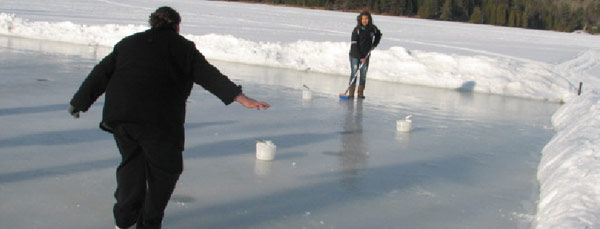
On February 9th, youth from Birch Island (Whitefish River First Nation) arrived at Anderson Lake and spent their afternoon at Anishinabe Spiritual Centre. They took advantage of the skating rink, curling with home-made curling stones. Other activities included snowshoeing and storytelling. For a snack, hot dogs were toasted over a roaring fire, and hot chocolate was served, steaming, sweet, and delicious.

 Youth Day at Anderson Lake

Fishing derby at the Anishinabe Spiritual Centre

Fishing Derby at the Anishinabe Spiritual Centre

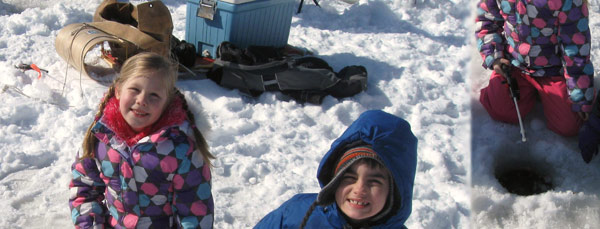
On the 19th of February, the ASC hosted the 5th Annual Espanola Children’s Winter Fishing Derby. The event was sponsored by the Espanola Game and Fish Protective Association. About 130 people were out on Anderson Lake over the course of a beautiful, sunny winter day. A total of 9 fish were caught (and released). This total of 9 is a record for this event.

 Fishing Derby at the Anishinabe Spiritual Centre

A Pin Hole Message from the Director of Anishinabe Spiritual Centre

Snow is here. The season is just around the corner. Changes careen across the landscape. Here at Anishinabe Spiritual Centre we are attentive to all of this & more. Thanks to many who come to this Centre and to the staff who hospitably receive them. From university groups, school awareness trips, the Native ministries community, support and healing groups, to retreatants, the ASC has welcomed them.  Our  meetings with Native community leaders are  invaluable learnings.  We keep listening to what the spiritual, communal and personal needs are.  We know that these are not easy times. For the youth, the elderly, the wounded, even the leaders, challenges are numerous.  Constant vigilance and progress is needed to be present to all of this. It is a blessing to have this season of Advent upon us, which teaches us vigilance, how to become more alert to what is happening and what is yet to come.  I hope this finds you all in that spirit, in anticipation of letting Christ enter  more deeply into our lives and our shared world. Thank you for all your support.  

Fr. David Shulist SJ


Worried about the youth, in the wake of suicides

At a recent meeting of the Ministries Programme, here at the Anishinabe Spiritual Centre, we discussed the current situation in our local Native communities. The number one concern of the participants was and is the young people on the reserves.

A desire was expressed to reach out and support these young people as an Anishinabe Spiritual Centre community, and to discern together how we might be able to do so.

Going through adolescence is not an easy time, as we all know. We struggle to find 

ourselves at this time of life, amidst a variety of competing influences. Here  at the Anishinabe Spiritual Centre, and in the surrounding communities, we mourn the fact  that the struggles  involved in growing up and taking on the mantle of adulthood have contributed to the suicides of some of our young people.

Whitefish River First Nation (WRFN) is a small community on the north shore of Lake Huron, about a 20 minute drive from the Centre. A number of Anishinabe Spiritual Centre staff members, Ministries participants, and other guests come from this community. WRFN has a fairly small population, with 1200 band members, 440 of whom live on the reserve. This community has suffered the loss of four people who have taken their own lives on the reserve, since February of 2009. All four were teenagers or young adults. Such losses prompt the members of the Ministries community and many others, such as Chief Shining Turtle of WRFN, to consider what might be done, what the community might do, to try to avoid such grievous events in the future. Such premature deaths also prompted a local newspaper, The Manitoulin Expositor, to publish a series of articles on the issue of suicide.

In one Expositor article, Elaine Johnston, executive director of the health authority that serves five local First Nations communities, suggested that it is helpful to talk directly to a person, if one suspects they might be having suicidal person, if one suspects they might be having suicidal thoughts. Her organization also helps to spread the word about crisis help lines.

Beyond such more immediate preventative measures, Ms. Johnston stresses the importance of strengthening families: “How do we encourage talking together, eating together, showing love?” Chief Shining Turtle wants community programs to be developed by the community itself, and wants them to address the needs of the whole person: spiritual, emotional, mental, and physical.

Here at the Anishinabe Spiritual Centre, we endeavour to take part in the struggles of our surrounding communities. We also hope to live up to our name, to be a spiritual centre for these communities. One of our Ministries participants recently commented that the predicament of the youth these days is that they lack any sense of a spirituality – whether Christian or traditional. May the youth, and may we all, grow in our sense of the presence of God in the world and in our lives, that we might see the goodness of life despite and through its many challenges.


Autumn Retreat Days at Anderson Lake

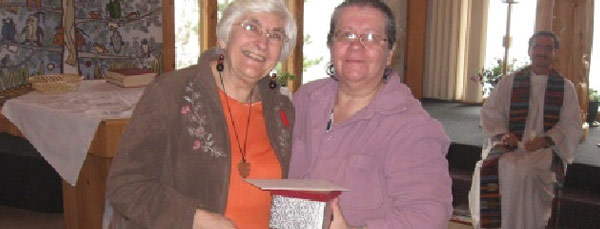
Dianne Musgrove presents a gift to Tarcia

Amidst the cooling days of fall, Tarcia Gerwing from Guelph came to lead a  group of the faithful in a prayer-filled three days of reflection and quiet meditation on the contemplative rules of Saints Benedict and Francis.


Reflections were interlaced with Gregorian chant and the gentle music of female mystics, whose words were put to reflective melodies. Tarcia’s quiet, modulated tones and the summoning of her “singing monk’s bowl” calmed everyone. Her gentle method of teaching was interspersed with many personal memories of her parents’ and siblings’ down-to-earth spirituality. Laughter and spontaneous prayer songs lent to a tranquil experience. At times, there were breakthrough “ahh” moments for some of the participants.

Silence was observed for most of the two days among most of the participants, allowing for some to talk at meal times and during the 

teaching and sharing sessions. The retreatants were also encouraged to go outside and take walks amid nature, in solitude and silence. Mass was celebrated each day in the larger Chapel, and included traditional Native smudging and the use of a hand drum to accompany songs.

Tarcia’s initial talk encouraged us to focus on Creation this weekend, and to try to really “listen” and “hear God” all around us, “to see God’s hand in all things”. 

The food prepared was, as always, delicious and very tasty, kudos to the cooks. The Centre staff also were attentive to the needs of the participants and provided a warm and relaxed environment.

Dianne Musgrove presents a gift to Tarcia

After the final Mass, on behalf of the retreatants, small tokens of appreciation were given to Tarcia, Gary & Linda (who had accompanied Tarcia from Guelph), the cooks, and the Centre staff. They included gifts of sacred sage, sweetgrass, and tobacco for their journey and to say Migwetch for sharing their blessings with us. The retreat ended with prayer, song, and sharing warm hugs and final farewells. Father David also assured us that Tarcia would return some time again, perhaps in the Spring, to lead another session. 

Story submitted by Dianne Musgrove, Ministries Programme participant


Message from the ASC Director

David Shulist

I was in the chapel the other morning & I watched a squirrel searching for his breakfast.  He was leaping across from branch to branch, with an ease that any dancer, familiar to such heights, would display. No symphony to accompany every precise move, but only the unstoppable northeast winds off of Anderson Lake howled in the background.   The choreography became trepid as this little creature would venture out onto the thinnest & supplest of branches to get the food that was out on the end.    

                 Life here at Anishinabe Spiritual Centre (ASC) has been quite a dance.  Since my arrival as new Director of the ASC on Anderson Lake in May, I have seen life teem.  We all know what dramatic changes occur from early spring  to early summer—the Centre has been no exception.  Fr. Mike Stogre, S.J., willingly handed over the duties of director to me.  Br. Gerry Forest returned, to keep the financial records in shape.  And then joining me as new members of ASC have been Fr. Alex Kirsten (from Midland)  & Paul Robson (Toronto via Nepal). Also on staff are Gerrie MacGregor  & Sylvia Shawanda, where kitchen is their domain, and Leonard Cywink  where every physical part of this Centre is his concern as maintenance man & builder.  And the latest member to join us is Nichkin, our dog.  Along with this group, there are Frs Doug McCarthy & Jim Kelly who are also part of the staff, and live and work in Native communities on Manitoulin Island.

So we are all being stretched: some in making room and others in finding their place in this setting, beautiful & so honest in its full display of seasons.  So far we have shared together two of them & we are into our third one: the time we have to go out on a limb & collect food, create programmes, hopefully all nourishment in the end, so that others like you feel welcomed and or want to help in some way to keep the ASC thriving.  This newsletter, Storyteller, is one attempt.  

There is so much more that I want to say & tell but for now, let us keep in touch. It is a privilege to be here & together I hope we can go out on a limb.  Miigwetch. 

Fr. David Shulist SJDavid Shulist